Object of Desire #1: Orville Moody Card
Good afternoon and welcome to Object of Desire, a recurring column where I review manufactured objects. Most editions of this subsection of Hydrangea will be behind a paywall but you know, just getting started, you need to get those shots up. A list of considerations I make when conducting my analysis: aesthetics, interest as a historical object, whatever other odd x-factor it may possess.
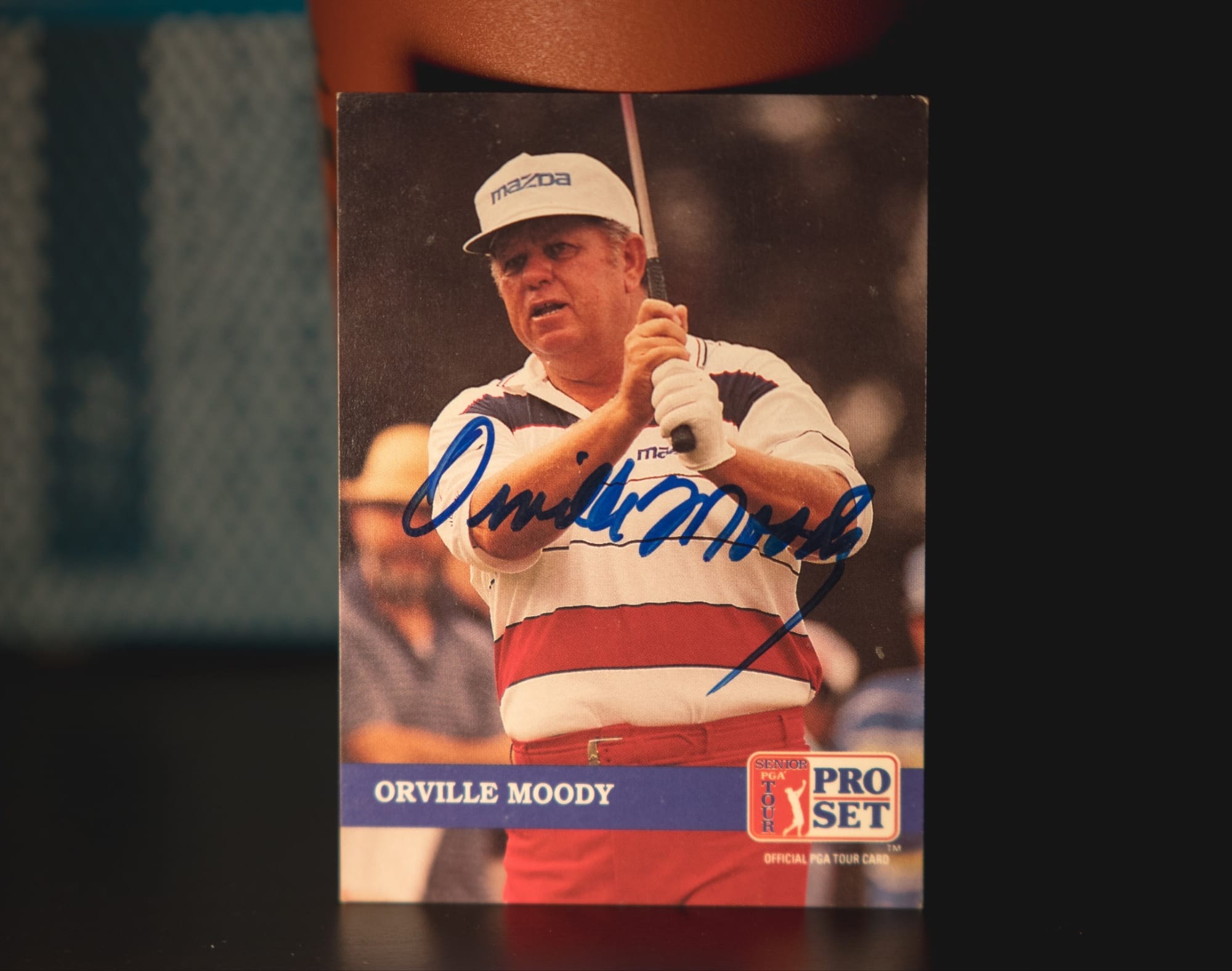
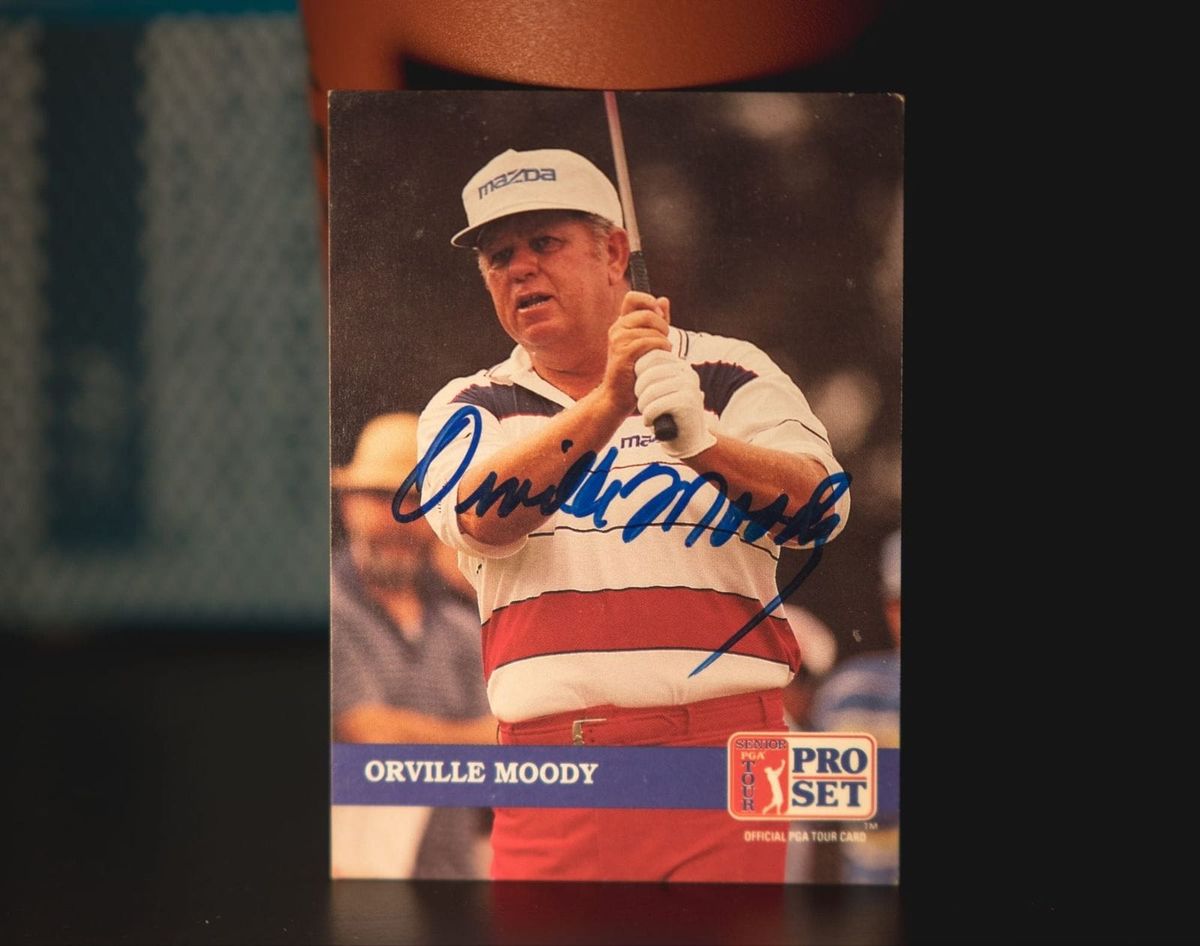
OBJECT: Orville Moody 1992 ProSet Golf Card, Signed
CONDITION: Fraying on the edges. The surface looks fine.
MARKET VALUE: Signed copy currently going for ten bucks on eBay. The marker he signed it with was a little fatter than mine and lacks a certain elegance I think my copy possesses. I would guess this elegance is worth a quarter.
WHAT I PAID AND WHERE: Five bucks at Super Sports Cards in Vancouver, WA
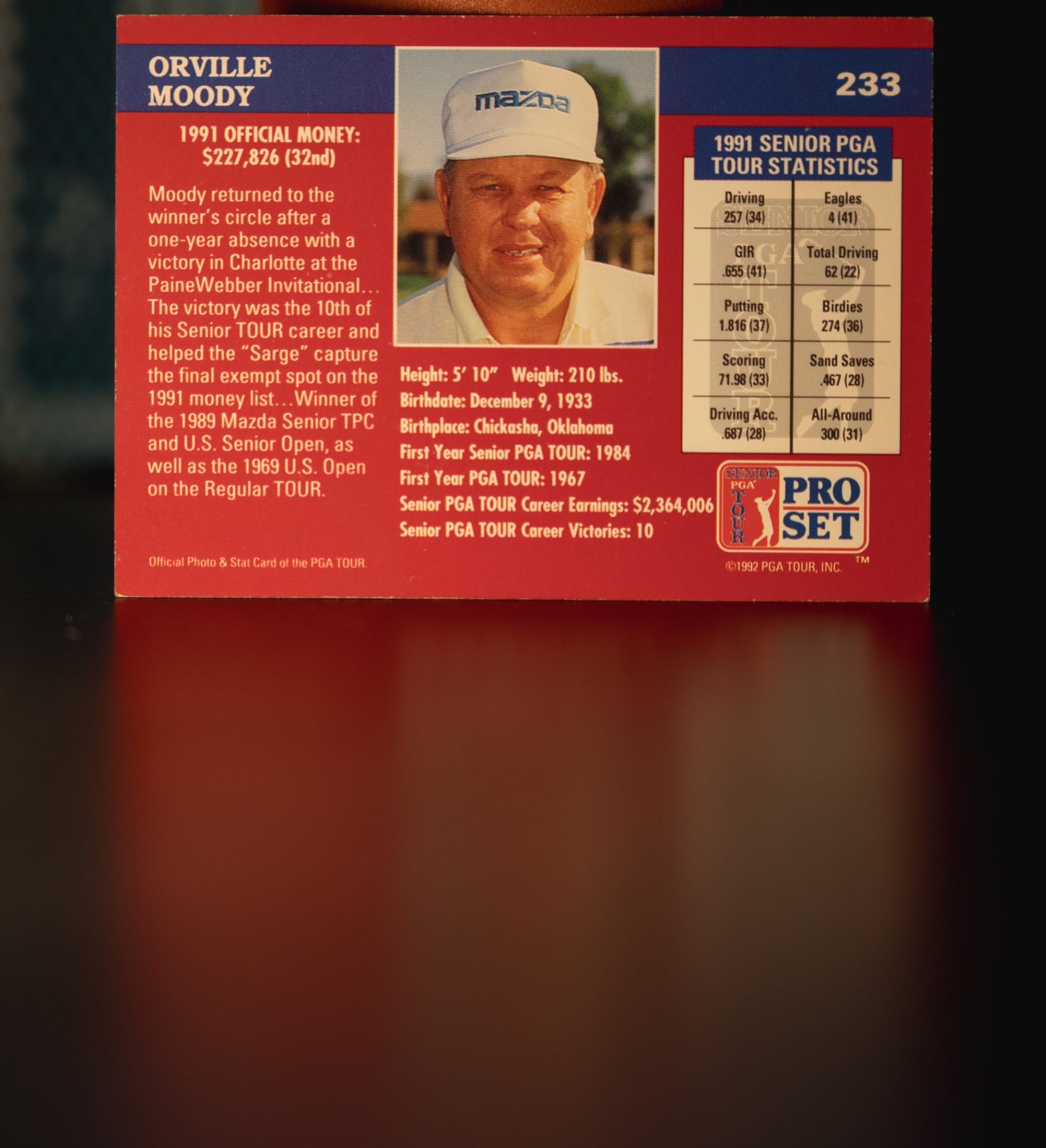
This is a senior tour card from ProSet, a short lived trading card concern that popped up at the height of the sports card speculative boom. One of their products was a golf line but the cards weren’t concerned with contemporary PGA golfers, instead exhibiting players from the Senior PGA Tour, a separate golf tour for old guys. This is how insane the speculation boom made the sports card industry in the early nineties: there were people who convinced themselves that the market would be all over cards with old men golfing on them.
The son of a golf course administrator and an accomplished young golfer on Oklahoma’s youth circuit, Moody flamed out of the University of Oklahoma a few months in and immediately signed up for the US Army, where he spent the first fifteen years of his adulthood. He was made a staff sergeant in the Army, where he dominated the inner-service golf scene. Moody made the rank of Staff Sergeant and was given charge over the Army’s various golf courses, where he supervised maintenance and taught the great game of the American upper class to generals, ambassadors, and children alike.
It is obscene that the Army has as many golf facilities as it does, in the same way that it was obscene how much money feudal societies spent on jousting, or like the very existence of the Coliseum in Rome was obscene. On some level this is the most acceptable kind of thing the American military spends money on, a gigantic makework program that serves the only rational purpose our imperial arm serves: keeping money flowing in our stagnant, rotten economy.
At the time when Moody was in charge I suspect the pure reasoning behind all this golf infrastructure was to make sure generals and soldiers could hang in elite spaces. Golf has never been a sport for the people or anything, but golf-as-upper-class-signifier was the default setting before Tiger Woods won the Masters, and there is utility in having your officer class inducted into the rituals of the wealthy. Earl Woods, Tiger’s father and the most-American American possible, learned to golf while serving and he took those skills and also the deep, disturbing madness he got in Vietnam, and used it to transform his son Tiger into the ultimate golf killbot/DUI master. When you’re measuring the amount of money the Army spent on these courses, try to remember that the program was partially responsible for Tiger, and factor that into your outrage calculations for good or for ill.
Moody had planned on making a whole career in the Army, “but it was always in the back of my mind that I'd like to make the tour,” he told the New York Times in 1968. “The only thing was, I didn't have that kind of money. Well, some people came along with some sponsor money, and here I am."
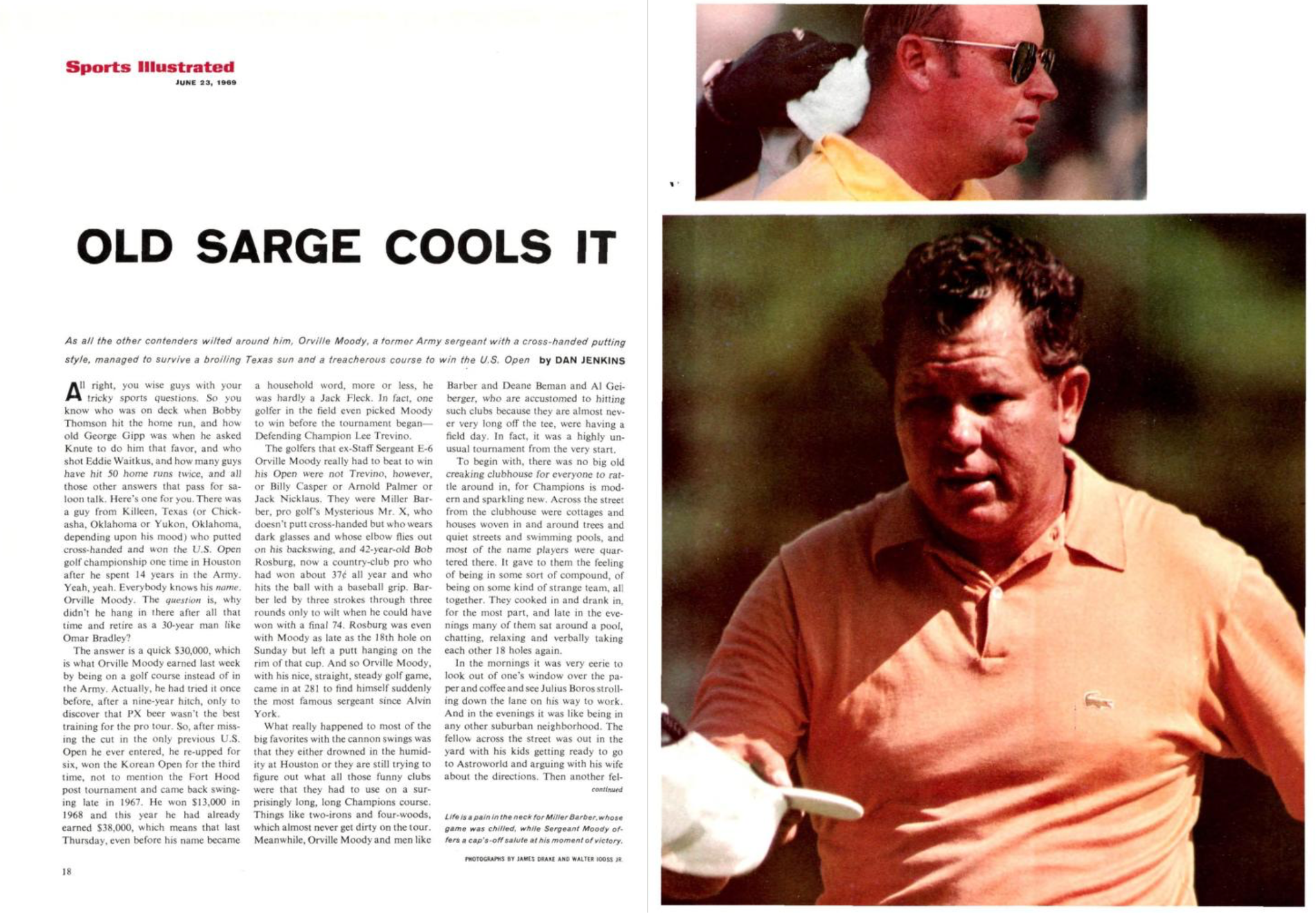
Moody only won a single PGA Tour event, but it was a big one: the 1969 U.S. Open, played at The Champions Golf Club in Houston, Texas. He qualified through lower level club play, the last winner of the Open to do so. Lee Travino, a friend of Moody’s, a fellow veteran and another middle class presence on the tour, predicted he would win before the Open. All the big boys ended up eating shit, leaving Moody, Miller Barber, and Bob Rosburg, a 42-Year old player who was already working full time as a club pro. In his SI Writeup of the tournament, Dan Jenkins speculates that the humidity and the remarkable length of the course forced big drivers to use “Things like two-irons and four-woods, which almost never get dirty on the tour.” Moody, on the other hand, didn’t really have big pop off the pine, was more skilled with the oddball clubs that were required, and managed to engineer a wild upset.
Richard Nixon called Moody to congratulate him after the tournament. "He said he wanted to congratulate me,” Moody told The New York Times. He said he thought it was a fine thing for somebody from the middle class to win the Open. He said that it's not often that somebody comes out of the Army to win the Open, and I told him it was the first time."
This statement is among the most Richard Nixon-ass things I've ever heard and also a perfect picture of the hole he shoved our cultural politics into that we’ve never really gotten out of. The virtue of the middle class, aiming for the big boys, a cultural class politics that filters its ambitions through overcoming the rich in controlled environments like sports, various rat race jobs, and the sleazy Navy poker games where Nixon got the money he needed to attend Duke Law School.
Nixon was cursed with this in his twisted, broken, drunken mind, and he sought to impress it on everyone else in the country and succeeded beyond his wildest dreams. Moody was his ideal kind of guy, an outsider who served his country by faithfully sticking it to the hoity-toity upper class old money guys in their own arena. The virtue of the clever middle class person remains the closest thing we have to a civic religion, an idol that keeps us from turning our heads and seeing the utility of class solidarity in the project of actually building a world worth living in.
Moody was an extreme creature of habit, who didn’t jibe with the discordance and inconsistency of life on the PGA Tour. “We had more fun in the Army. You don’t realize the security there. I always had a place to sleep, a place to eat and I always got paid. The money is too good now to go back. But I was happier then.” Moody would compare himself unfavorably to Lee Trevino, who thrived on the chaos of the road.
After his PGA Tour retirement Moody got a job as a club pro in Texas and hit the senior tour when the time came. He was a good senior player; an especially adept putter, in demand enough as a personage that someone, somewhere, insisted on getting his card signed sometime in the early 90’s. When you see autographed cards you often wonder where they got signed. I suspect Moody penned this on an SPGA Tour stop. Perhaps when he was walking out of the bathroom or doing recon on the buffet.
I didn’t know any of this interesting stuff about Orville Moody before I bought this thing. I bought it because I liked the look of it and because the idea of SPGA cards was insane to me. His outfit here is wild, a combination of Rodney-in-Caddyshack dress, hardcore patriot red-white-and-blue and a classic Mazda snapback, the kind my car enthusiast family members might have sported.
It’s an image of Nixon’s man, the “Humble” middle class striver, coming into the new globalized economy, a place where Japanese car companies were paying retired US Army Golf Specialists to promote their cars. His bright red pants are kooky, built for a patriotic golfer or the bassist in a mid aughts indie rock band and for no one in between. The guy in the back, fuzzy in the frame while wearing a straw hat and a purple polo and a salt and pepper beard is also dripping a little, I think.
The post-Caddyshack slob-golf aesthetic is one of those vibes that seemed oppressive at the time but has a kind of warm vibe in retrospect. Tiger, the fully realized globalization golfer, with his tasteful red shirts and his howitzer biceps and his fake military service, represented a clear break from all that, the 21st Century’s power minimalism coming into focus. This is now the oppressive aesthetic. Seeing this card felt like a brief release.