
The Inner Life of the Contemporary Scalper
Kiyoshi Kurosawa’s 2024 psychological thriller/Coen brothers pastiche Cloud begins with a grim sequence. Ryosuke Yoshii, played by Masaki Suda—in a classic dead-eyed Kurosawa performance—is in a warehouse with a married couple trying to sell their inventory of therapeutic devices. They are broken and sad, washed up on the back end of a failure that will come to define their lives.
Yoshii offers 3000 Yen a unit for the lot of thirty devices, about 20 dollars a pop in USD, six hundred dollars in total. The Husband blanches: the retail price for the units is nearly 400,000 Yen, and he has shouldered development and marketing costs in this venture. Yoshii tells them that junk removal will cost more if they don't get rid of them soon, drops 90,000 yen cash on a table, loads the devices into his small canopy truck, and leaves the wreckage of these poor people’s lives behind forever.
Yoshii arrives at home. He unboxes one of the devices, takes some pictures with a DSLR and a LED Light setup, and offloads them on a Temu-like website at 200,000 yen a piece; more than twice what he paid for the units in total.
Then he opens a bottle of water, sits about ten feet away from his computer and stares at the screen with a disaffected stare, blinking blue SELL icons symbolizing the unsold units. One turns orange—someone put it in a cart—then red: product sold. Then another, and another, and another, until they’re all sold out for good. 6,000,000 yen, nearly 38,000 Dollars, all for an afternoon of work and a total devotion to the market. The mask breaks, he closes his eyes, tips his head back, and exhales.
The audience wonders: relief or pleasure?
___
Later in the movie, we see Yoshii executing another reselling scheme. A collectables shop is selling some kind of new anime girl model and a line is curling around the block before opening. Yoshii has managed to sneak inside the shop and is parlaying with the owner, offering two times MSRP to buy out his supply before the store opens. The owner relents, Yoshii loads his little truck and manages to sneak away before the owner sticks a big ‘Sold out’ sign on the door of the shop, leaving the line full of local anime statue enthusiasts in agony.
As the movie resolves its main conflicts, Yoshii’s anime statue gambit plays out in the background. By the end of the movie’s primary rising action, he managed to sell all the statues for 10,000,000 Yen in profit, about 63,000,000 USD. With the therapy machines, Yoshii has preyed on the desperation of people beaten by capital. With the statues, on the other hand, he feeds on the aura-hunting of collectors, enthusiasts; of people who want stuff and can afford to pay way too much money for it.
____
A few years back, I covered the National Card Show, the world’s biggest sports cards and memorabilia gathering. I was pretty mystified by it at the time. But the feeling of walking around a big convention floor, listening to people's odd little conversations, doing little deals and hunting for an object of desire—I came to enjoy it. It’s fun, and you can get into it without spending much, so long as your desires aren’t that extravagant. And if all you’re collecting is cards, it doesn't even take up that much space.
My preferred indulgences are weird sports autograph cards and Pokémon cards. I enjoy the sports autos because I like sports, I like weird shit, and the supply of weird sports autographs is inexhaustible. Pokémon cards I got into for what I’m telling myself is a bifurcated reason: I like Pokémon stuff, and the art on Pokémon cards is really good. It gives me a good reason to go to a card show and zone out for a while, something I enjoy more than I should.
When I got into it, packs were freely available, occasionally below MSRP if you were trawling at a show or a card shop. Pokémon vending machines, big Pokeball-adorned monoliths that sit at the entrances of the supermarkets, were loaded with packs, and a poor guy like myself could reliably slip a fiver into the machine and get a little pack of vice to tear open back home, and feel a small gambling rush before the pack fizzles out in your hand. But around the release of the Surging Sparks boosters, speculation was emerging. There was a Pikachu card people wanted, it was worth a lot, and people were starting to buy out retail stock en masse. And then these things came out:

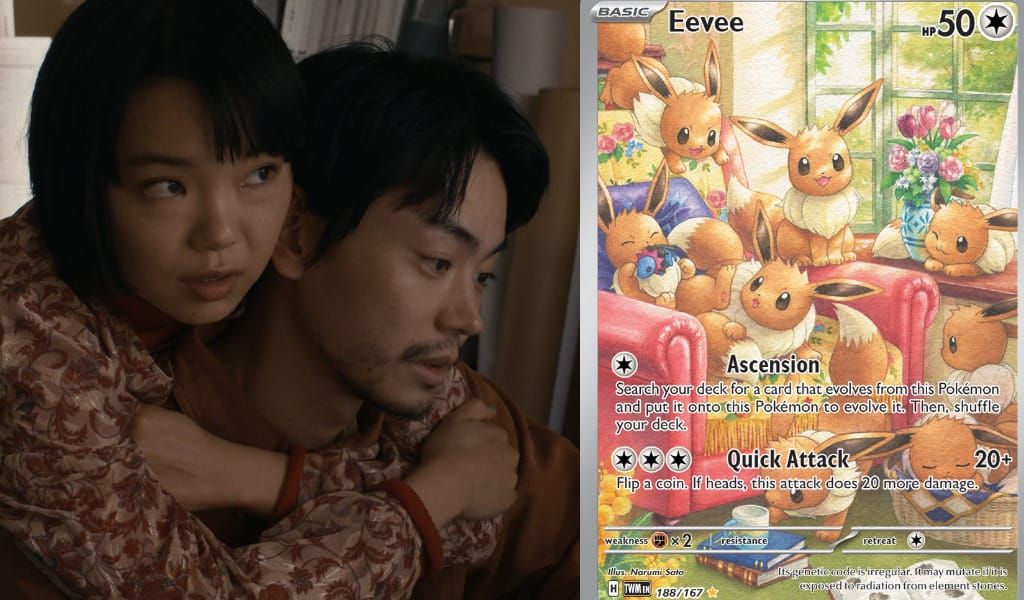
The Prismatic Eeveelution Special Illustration Rares… people have killed for less, folks. We’re talking a thousand dollars raw, straight out the pack. You’re still paying around five grand for the Umbreon SIR in a PSA Ten… it was madness*. The market on Prismatic Evolutions never adjusted into something sane. I’ve never managed to open a single pack of these bad boys because I refuse to pay more than a dollar over MSRP for a pack and I have never seen one in a store or a vending machine, and there’s at least six Pokémon vending machines within walking distance from my house.
That doesn’t mean I don’t want one. I like the garish church window art, I like Eevee Guys. Not enough to pay a fuck ton of money for one, but if I managed to pull it from a pack I bought I would get it graded and I would feel a tinge of sadness when I sold it to buy something I actually needed. The Pokémon company hires good artists who make a good product. While Magic is succumbing to the branded slop gods and sports publishers sleepwalk through their twentieth consecutive season, the people in charge of Pokémon have devoted themselves to making a handsome product that keeps collectors interested (a shame the game stinks). People want this stuff, they’re willing to pay for it, and, uh oh, oh God, can you hear that:
Scalping is nasty work, even if most scalpers don’t end up in Coen Brothers schemes. Scalpers get in brawls in public, buy shit under the nose of literal children, build bots to stalk online retail sellers and auto-purchase as much stock as possible, loiter around Pokémon vending machines swiping multiple credit cards; they build weird vending machines, or deal in stolen merchandise, engage in low-grade market manipulation. You might have heard about the guy who got arrested after leaving his daughter camping outside of a South Carolina Target (terrible guy), or the guy who tried to camp out in a Best Buy overnight to catch that drop (not a GOOD guy necessarily, but he possessed an admirable grind). An unpleasant cohort of an unpleasant type of guy, to be certain.
Everyone who makes and consumes content about Pokémon cards fucking hates scalpers. Scalpers are surveillance addled creeps who drive Teslas, or deadbeat dads, money thirsty maniacs who ruin the hobby, fake-ass fans, and losers who sell Pop-Tarts on eBay—among other things. The Scalper is ruining the hobby, making packs of cardboard slips prohibitively expensive for everyone aside from psychos with too much money too little self-control. They encourage you to not deal with these people, or, if you wanna put your back into it, draw them out of their caves by lying to them over Facebook Marketplace, or post videos of you wasting their time as much as humanly possible.
Recently, scalpers took a pretty funny hit. The Pokémon 30th Anniversary set came out earlier this year and the hype was psychotic: the pull rates were good, some of the cards were extremely sick and everyone who was invested was resigned to scalper malfeasance drowning the fun as soon as possible. But then something strange happened: The Pokémon Company decided to dramatically over produce a set with reasonable hit rates, driving the price of ETBs down, drastically cooling the market and leaving people who dumped their time and money into what seemed like a nice clean scalp right into the fucking garbage. Some scalpers overreacted on the internet. Anyway, it's pretty funny.
But when I watched this video of a content guy reading a scalper’s tirade against the Pokémon company, I felt something strange. Something beyond schadenfreude? Pity? Oh God, oh no.
___
I've been thinking a lot about Billy Evans. Why has Billy decided to attach himself to such a lost cause like Elizabeth Holmes, a person currently in federal prison carrying around hundreds of millions of dollars in restitution debt? In thinking about this question I have come as close as I can to seeing a kind of romance in Billy. Not for Elizabeth, necessarily, but with pure good old fashioned American striverism.
Billy Evans grew up in a wealthy family who made their money in luxury hospitality. This means that he was rich and connected enough to be around billionaires and poor enough to really understand the yawning fucking gap between his own middle bourgeoisie class and the demonic bourgeoisie billionaires who actually run the world.
Billy craves power and respect, the stuff you get when you walk into a room with a net worth that should be illegal. Billionaires are feudal masters, the dream of kinghood made manifest through our broken economy. If we lived in a world where we were given truly democratic values and ethics, his dream would be an object of ridicule. Why would anyone want to be a King? Kings should even exist. Unfortunately, Billy Evans’s values and ethics come from America.
When he meets Elizabeth, he does basic calculus. This person was once a master of the universe. Maybe I can make them whole again and reap the rewards of power and glory that would follow. I know that I will not have many chances at making this happen for myself. This is what he sees in Elizabeth: a distressed asset. He perhaps also loves her, I think; emotions are messy and ambivalent and complicated. But Billy is doing what every striving person in America does: he is engaging in arbitrage.
As people, I have nothing but contempt for Billy Evans and his brothers on the Pokémon card scalping grind. It’s nasty stuff they get up to, beneath human dignity. But they have a common understanding of a pure and simple truth about life in America and/or late Capitalism: that materially, arbitrage is the only thing that really matters, the key to the door that gets you from one level to the next.
In the case of Evans, who was born lucky, it’s gilding the lily a little. You’re good, dude. But for the scalpers standing outside of suburban Targets in sub-freezing temperatures, just to get a taste?, I can’t help but put them in a macro. For the last two or so years the cheapest, highest yield arbitrage opportunity out there was mass purchasing Pokémon cards from anyone selling product at MSRP and flipping them at a short term gain. This is the only sure way these guys have to scratch out of the basement we're all condemned to live inside and haul their way into something resembling a dignified life.
Here is a lengthy archival video of a streamer tracking Pokémon scalpers and giving them employment applications as a troll. I get the impulse, of course. The surface values that capitalism puts in us suggest that hard work and service to others is the path of prosperity and he is seeking to enforce those values for clout. But like: have you lived here long? You think that ‘Being employed in America’ is a path to anything resembling security or dignity? Working for a living in America is terrible AND it leaves you destitute! This guy is doing exactly what the economy wants him to do.
Our perverted economy shocks and appalls me as both a Pokémon card collector and as a citizen. But this is what the incentives of capitalism in America create. You don’t hate scalpers, my brothers and sisters, you hate capitalism, where everybody is scalping to each other from the bottom of the pyramid to the fucking top, where riding the whims of mass delusions about value are the only way to get anywhere.
But then again… what even is card collecting without capitalism?
Here is the life cycle of a collected object. It is first purchased, on eBay, at a collectables show, drawn from a pack of something. Then, it is held in storage of some sort for a while—sometimes on display, sometimes not. You might show it to someone, look at it while flipping through your stuff, but, really, in its being acquired, it has achieved one half of its ultimate purpose. Time goes on. The value of the object changes based on the adjustments of the mass delusion blob that determines how much all collectables cost. If you’re lucky or good at performing arbitrage, the object will have increased in value, even as your personal attachment to it has withered away. Soon, the collector desires something else, and the object, once reeking of aura, becomes mere fuel for the next big purchase. In selling, a moment of recurrence of former longing, a pang of nostalgia for the original moment that brought you to the object in the first place, along with a profit, ideally, or a loss. The next object is purchased, imbued with the aura of the new. The cycle starts over.
This brings me back to Yoshii, watching the bars turn red and shuddering with either relief or pleasure or both. Sailing on the market is stressful, but when it goes your way it feels good. Market economies wouldn’t exist if there wasn’t some rush that they fed. The social world of card collectors is based on both sincere desires and sincere friendships, of course, but they are undergirded by the affective foundations of buying and selling. What even is card collecting without a market economy, and what even is a market economy without opportunities for arbitrage? Can card collecting and scalping ever be extricated from each other, when they’re feeding on the same emotions, the same system of abstracted value? What would the hobby even be if capitalism fell to the wayside?
*Editor’s note: it’s curtains for Zoosha